Beyond Cost: 80% FIBC Failures Stem From Unsafe Operations
RUNCHEN
AuthorWith more than 25 years of experience in FIBC bulk bag manufacturing and sales, RUNCHEN operates its own production facility with stable batch capacity. We specialize in FIBC bulk bags, jumbo bags, ton bags, and customized industrial packaging solutions.
Beyond Cost: 80% of FIBC Failures Stem From Unsafe Operations
In the bulk packaging industry, conversations with FIBC (Flexible Intermediate Bulk Container) buyers often revolve around price per unit and basic compliance. While these are important, they represent only the visible tip of the operational iceberg. A deeper analysis of real-world challenges reveals a critical, and often silent, pain point: unsafe operational practices. Industry experience and case studies suggest that a staggering 80% of premature FIBC failures and related incidents can be traced back to improper handling and integration, not product failure. Shifting focus from mere cost to operational safety and system integration is the key to unlocking true efficiency and risk mitigation.
The Silent Cost of Operational Blind Spots
Purchasing a high-specification FIBC is only the first step. Its performance, longevity, and safety are overwhelmingly determined by what happens after delivery. The case of Shandong Lusu Packaging is instructive. Their solution wasn't a new bag design, but comprehensive safety guidelines. They addressed fundamental yet commonly ignored practices: prohibiting personnel from standing under suspended bags, ensuring hooks are centered on loops (not slung), and protecting outdoor-stored FIBCs from UV and moisture. These aren't advanced engineering concepts; they are basic operational disciplines that, when neglected, lead to tears, falls, and accelerated aging.
This highlights a pervasive market gap. Content and discussions are saturated with cost-per-handle calculations, while the substantial "hidden costs" of operational risk—workplace accidents, production downtime, product contamination, and collateral equipment damage—remain under-communicated. Investing in operational knowledge delivers a far greater return by protecting your entire material handling process.
Building a Culture of FIBC Safety: A Practical Framework
Moving beyond vague warnings requires a structured approach. Safety must be embedded into every touchpoint of the FIBC lifecycle. Consider implementing this actionable audit framework:
- Receiving & Storage: Inspect for shipping damage. Store indoors when possible; if outdoors, use protective covers as per Shandong Lusu's guidelines. Keep bags off damp floors.
- Handling & Lifting: Enforce clear zone management. Use appropriate lifting devices (spreader bars are ideal). Train all personnel on the critical rule: never stand under a suspended load.
- Discharge & Integration: This is where risk compounds. Ensure the FIBC discharge spout is compatible with your receiving hopper. Use proper tie-off techniques to prevent sudden material release.
- Decommissioning: Establish clear procedures for emptying, inspecting, and disposing of or returning bags. A torn bag sent for reuse is a future hazard.
This procedural mindset transforms safety from a checklist into an integrated component of your workflow, directly addressing the root causes of most failures.
System Integration: The Force Multiplier for Safety and Efficiency
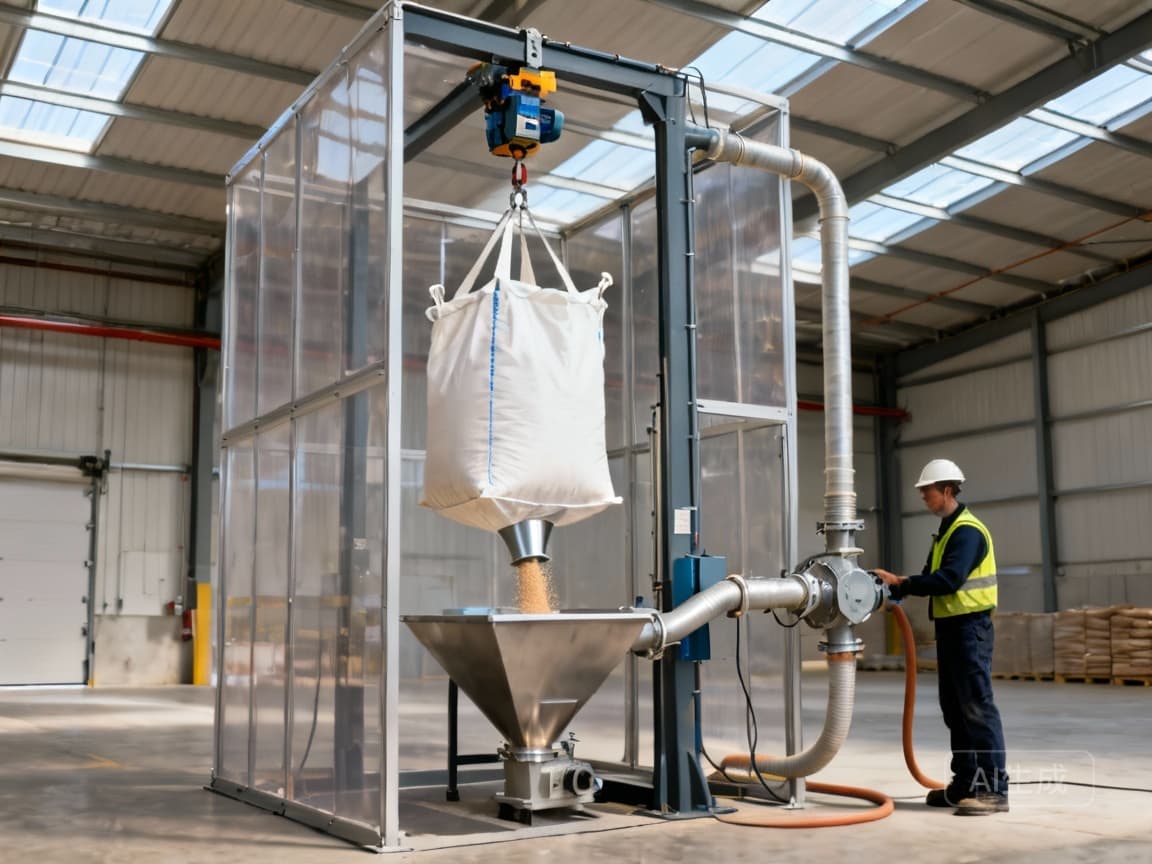
True operational excellence views the FIBC not as an isolated container, but as a critical node in a broader material handling system. This is where safety and efficiency converge. The Endema case study provides a powerful blueprint. They solved for "efficient, dust-free FIBC unloading" not just with a bag, but with a customized "unloading station" system. This integrated solution included controlled lifting, sealed spout clamps, dedicated discharge hoppers, and connected dust collection.
The lesson is profound. By designing the interface between the FIBC and the downstream process, Endema engineered out major risks: manual handling injuries, dust explosions, and cross-contamination. Their implementation experience offers further crucial insight: for brownfield (old plant) modifications, integration must work around existing layouts without compromise. For greenfield (new plant) projects, the system must be designed with future flexibility and automation upgrades in mind.
“The most effective safety device for FIBC discharge is often not on the bag itself, but on the station designed to receive it.” – Principle derived from integrated system providers.
Linking Trends to Operational Practice
Emerging market trends further necessitate this integrated, safety-first approach. The strong growth of the global mono-material packaging market, projected to reach $5.63 billion by 2029, is driven by recyclability demands. For FIBCs, this means designing for end-of-life recovery, which directly influences material choices and, consequently, handling characteristics like UV stability and static dissipation.
Similarly, the booming cosmetics and high-value chemical sectors require FIBCs with advanced liners and cleanliness protocols. Here, an operational misstep—such as using a contaminated bag or causing static discharge—can ruin an entire batch of high-value product. The trend data underscores that operational precision is becoming a competitive necessity, not just a safety bonus.
Conclusion: Redefining the Value Proposition
The path forward requires a fundamental perspective shift: from being a product purchaser to becoming a process optimizer. The goal is not to find the cheapest bag, but to achieve the lowest total cost of ownership, where "cost" includes the immense financial and human toll of preventable failures.
By prioritizing operational safety through structured protocols and embracing system-level integration thinking, businesses can directly target the source of 80% of their FIBC-related risks. The data from real cases and market trends confirms that this is where the greatest untapped value—and the most significant risk reduction—lies. Start auditing your handling practices today and view your next FIBC not as a commodity, but as a component to be seamlessly and safely integrated into your production ecosystem.
Related News
Other news you might be interested in
Choosing a Bulk Bag Manufacturer: Reduce Packaging Risk and Improve Supply Reliability
Use a practical supplier qualification framework to match FIBC specifications to your material, equipment, compliance needs, and delivery schedule—and reduce sourcing risk.

How to Qualify a Bulk Bag Manufacturer for Reliable, Compliant Packaging Supply
Use this practical framework to assess bulk bag specifications, quality controls, compliance, delivery reliability, and total cost before choosing a manufacturing partner.
Want to know more?
Get in touch with us for more information about our services and products.