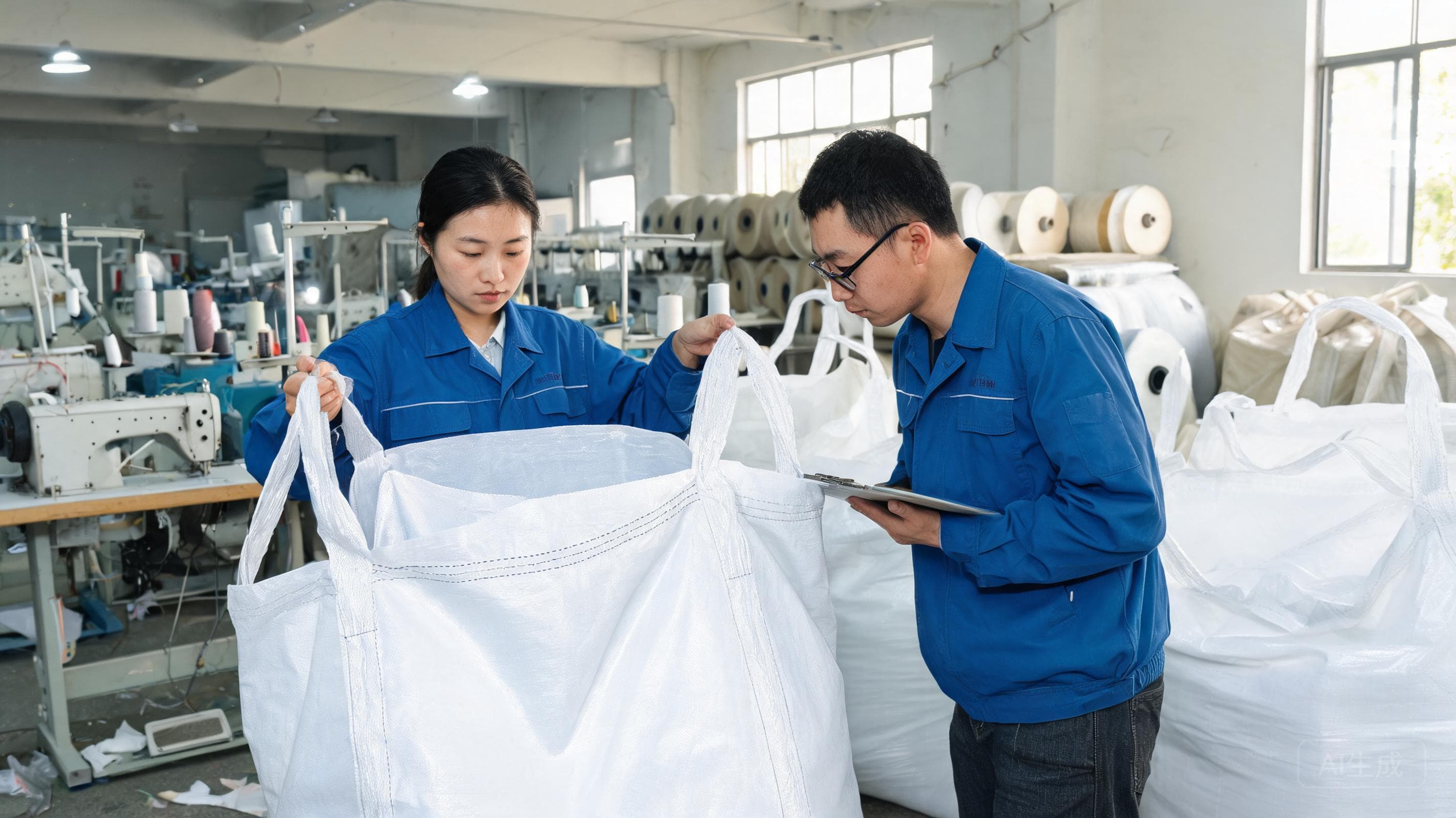
Choosing the Right FIBC Manufacturer: A Practical Guide to Safer, More Reliable Bulk Packaging
RUNCHEN
AuthorWith more than 25 years of experience in FIBC bulk bag manufacturing and sales, RUNCHEN operates its own production facility with stable batch capacity. We specialize in FIBC bulk bags, jumbo bags, ton bags, and customized industrial packaging solutions.
Start with the Application, Not a Catalog
Choosing an FIBC manufacturer is more than a purchasing decision. For procurement, quality, and operations teams, an unsuitable bulk bag can lead to product loss, damaged goods, delayed shipments, handling difficulties, production interruptions, and added safety risks. Unclear specifications or supplier changes can create uncertainty across the supply chain.
Packaging performance is receiving greater attention across logistics. The 2024 ISTA China annual meeting discussed the demands of a 100 billion parcel era and the growing importance of packaging performance and circularity. Parcel delivery and bulk material handling are different environments, but both face increasingly complex supply chains with little room for packaging failures.
A bulk bag that works well for one material, filling process, or transport route may not suit another. Load characteristics, lifting methods, discharge equipment, storage conditions, and handling frequency all affect the right specification.
This guide explains how to evaluate an FIBC manufacturer based on its ability to understand your application, recommend suitable construction, control production quality, and support reliable repeat orders.
Before comparing standard products, define what the bag must do and how it will be used. Start with the product itself. Your manufacturer should ask about:
- Target fill weight and required bag dimensions
- Particle size, density, and flow behavior
- Moisture sensitivity and moisture-protection needs
- Dust control, contamination concerns, and cleanliness requirements
- Whether the material is abrasive, sharp, sticky, free-flowing, or prone to bridging
- Special handling, regulatory, or customer-specific requirements
Map the full use cycle: filling, lifting, movement, stacking, storage, discharge, and final disposal or reuse. A bag may face different stresses at each stage. It may fill efficiently but still be unsuitable if its lifting loops do not match the forklift configuration, its discharge design slows operations, or its fabric cannot withstand repeated movement.
Operating conditions matter, too. Consider indoor or outdoor storage, moisture exposure, airflow requirements, abrasion during loading, and how many times the bag will be handled. These details can affect fabric selection, coating, liners, loop configuration, closure design, and reinforcement.
Identify purchasing and compliance requirements early. Document dimensions, safe working load, safety factor, filling and discharge features, liners, printing, labels, and required approval documents. A capable FIBC manufacturer should ask detailed questions before recommending a bag rather than treating every request as a standard specification.
Match Bag Construction to Handling and Product Needs
Product names can be useful starting points, but they should not replace a specification review. The right construction depends on your product, load profile, equipment, logistics flow, and acceptance criteria.
A Top-Lift Bulk Bag may be worth assessing when lifting configuration and compatibility with handling equipment are central to the application. The number, placement, and design of lifting loops should match how operators or forklifts engage the bag. Confirm the lifting method, fork dimensions, handling angles, and expected movement before finalizing the design.
An Internal reinforcement ton bag may suit applications requiring added structural support. Reinforced construction can address specific load and handling demands, but suitability must be confirmed against the product weight, loading method, stacking conditions, and transport process. Additional material alone does not replace a properly engineered design.
A COSEK Ventilated Bulk Bag may be considered when airflow is important to the product or process. Ventilation can be relevant to certain agricultural, food-related, or moisture-sensitive applications, but the required airflow and product compatibility should be confirmed with the manufacturer before production.
A COSEK Tear-Resistant FIBC Bulk Bag may suit applications where abrasion, rough handling, sharp product characteristics, or demanding movement conditions are concerns. Assess performance against the actual operating environment rather than relying on the product category alone.
Look beyond the bag name when comparing options. Ask for details about fabric type and weight, coating, seam construction, lifting features, reinforcement, liners, closures, printing, and customization. A reliable manufacturer will explain which features address a real application need and which may add unnecessary cost or complexity.
Evaluate the Manufacturer’s Quality System
FIBC quality is built into the process well before bags are packed for shipment. The manufacturer should be able to explain its controls for incoming materials, weaving, cutting, sewing, finishing, inspection, and final packing.
Ask how specifications are documented and acceptance criteria agreed before production. For new orders, request details about testing and inspection practices relevant to your application. General quality claims are not enough; you need evidence that the supplier can consistently produce the bag you approved.
Ask questions such as:
- How are raw materials inspected and identified?
- How are fabric, loops, sewing thread, liners, and accessories controlled during production?
- What checks are performed during cutting, sewing, finishing, and packing?
- How are inspection records maintained for each production lot?
- How does the supplier manage traceability, nonconformance, and corrective action?
- What happens if materials, equipment, or production processes need to change?
For new or revised specifications, ask whether samples, pre-production approvals, and production-lot checks are available. Review supporting documents and sample results directly. Quality claims should be supported by application-specific evidence, not only a general certification or brochure description.
Look Beyond Unit Price to Total Cost in Use
The lowest quoted price does not always deliver the lowest operating cost. A bulk bag that leaks product, slows discharge, requires extra handling, or increases rejection rates can cost far more than the initial difference in unit price.
Evaluate quotations against total cost in use, including:
- Bag durability through the full handling cycle
- Risk of product loss, contamination, or damage
- Filling and discharge efficiency
- Compatibility with lifting, conveying, and storage equipment
- Storage and stacking requirements
- Operational disruption from failures or inconsistent performance
- Replenishment reliability and lead-time stability
Ask the supplier to explain the trade-offs behind its proposed specification. Which choices affect cost or lead time? Which improve durability or simplify handling? A reliable manufacturer should help distinguish features that add value from those your process does not need.
For a new, modified, or operationally demanding application, run a controlled trial with agreed success criteria. Measure performance against a baseline rather than assuming projected savings. Useful measures include damage rates, filling and discharge times, rejection rates, handling incidents, and supply continuity.
Treat Sustainability and Material Supply as Procurement Questions
Evaluate sustainability in practical operational terms. Consider material selection, opportunities for reuse where appropriate, end-of-life handling, customer requirements, and applicable regulations. The right approach depends on the product, supply chain, handling conditions, and local disposal or recovery options.
The 2024 ISTA China annual meeting’s reference to a 100 billion parcel era and a projected circular packaging market reflects broader attention to packaging systems and resource use. FIBC buyers should assess circularity options for their own applications rather than applying general packaging trends without verification.
An industry report on aluminium cited historical metallurgical alumina output of 130.4 million tonnes. This is not an FIBC market statistic, but it illustrates a broader procurement reality: upstream material markets, logistics conditions, and industrial demand can change. Buyers should not assume supply availability or pricing will remain static.
Ask how the FIBC manufacturer manages raw material sourcing, lead-time changes, production planning, and communication when market conditions affect supply. A proactive supplier should explain how it handles potential disruptions and when it will notify customers about changes that could affect an order.
Do not treat broad market figures as proof of a supplier’s sustainability performance or delivery reliability. Request relevant evidence about the product, production process, and the supplier’s planning controls.
Use Data Carefully When Comparing Suppliers
A structured supplier scorecard helps procurement teams make decisions based on comparable evidence rather than isolated claims. Assess shortlisted FIBC manufacturers against criteria that reflect your requirements, such as:
- Specification fit and technical understanding
- Quality controls and traceability
- Sample quality and trial performance
- Customization capability
- Delivery reliability and communication
- Responsiveness to changes or quality issues
- Commercial terms and total cost in use
Request comparable evidence from every shortlisted supplier. This could include inspection records, sample evaluations, documented production controls, agreed specifications, and service-performance information where available.
Be cautious with statistics that lack a clear definition or a direct connection to FIBC manufacturing. For example, a separate research-track source reports a 0.10% figure, but without a clear measurement method or direct relevance to bulk bag production, it should not be used as a product benchmark or supplier ROI claim.
Separate verified customer outcomes from broad industry statistics. Before using any figure in a procurement decision, confirm the timeframe, measurement method, application conditions, and comparability to your operation. Track trial outcomes against a baseline so improvements are visible and defensible.
Questions to Ask Before Requesting a Quote
A detailed request for quotation helps the manufacturer recommend a suitable bag and lets your team compare offers accurately. Before requesting pricing, ask:
- What information do you need about our material, filling process, lifting equipment, and transport conditions to recommend a suitable FIBC?
- Which options—including a Top-Lift Bulk Bag, Internal reinforcement ton bag, COSEK Ventilated Bulk Bag, or COSEK Tear-Resistant FIBC Bulk Bag—should we evaluate for this application?
- Which product specifications and inspection criteria can be agreed before production?
- Can you provide samples or support a production trial, and what information will be documented?
- How do you manage order changes, material availability, lead times, and quality issues?
- What customization is available for dimensions, lifting features, closures, liners, printing, labels, and other application requirements?
The answers should demonstrate more than product availability. They should show whether the supplier can translate your operating conditions into a controlled, repeatable bulk packaging solution.
Follow a Low-Risk Path from Specification to Repeat Orders
A structured sourcing process can reduce uncertainty before volume production begins:
- Share application details. Provide information about your product, target load, filling process, handling equipment, transport route, storage conditions, and discharge requirements.
- Review the proposed specification. Confirm dimensions, fabric and seam details, lifting features, closures, liners, printing, safe working load, and inspection expectations.
- Assess samples. Review workmanship, usability, and specification fit before committing to a production order.
- Approve a controlled trial. Establish success criteria and test the bags under realistic operating conditions.
- Evaluate trial results. Compare handling, damage, efficiency, and operational fit against the agreed baseline.
- Confirm production controls. Agree on approval records, quality checks, change management, packing requirements, and delivery expectations before scaling.
Before placing a production order, define responsibilities, approval checkpoints, escalation contacts, and communication expectations. Keep the approved specification and change records accessible to procurement, quality, and operations teams.
Use feedback from the first order to refine the bag design and supplier relationship. As volumes, materials, equipment, or operating conditions change, review performance periodically to confirm the original FIBC specification remains suitable.
Turn Your Packaging Requirements into a Manufacturer Conversation
Reliable FIBC sourcing begins with a precise application brief, evidence-based supplier evaluation, and clear acceptance criteria. The aim is not to select the most generic bag or the lowest initial quote. It is to secure a bulk packaging solution that supports safer handling, dependable operations, product protection, and repeatable supply.
Prepare details about your product, load requirements, filling and discharge process, lifting method, transport conditions, storage environment, and operating challenges. This information helps determine whether standard construction, reinforcement, ventilation, tear resistance, liners, customized lifting features, or other options are appropriate.
Send your application requirements to our manufacturing team to discuss a suitable FIBC specification, customization options, samples, and a controlled trial. Contact us to start your bulk bag review.
Related News
Other news you might be interested in
Choosing the Right FIBC Bulk Bag: A Buyer’s Guide to Safer, More Reliable Shipments
Compare FIBC bulk bags by material, handling conditions, safety requirements, and total cost. Use this practical guide to define specifications, assess suppliers, and plan a trial.
Choosing the Right FIBC Bulk Bag: A Procurement Guide for Safer, More Reliable Packaging
Use this practical FIBC procurement guide to define your application, compare specifications and suppliers, verify compliance, and request a bag configuration that fits your operation.
Want to know more?
Get in touch with us for more information about our services and products.