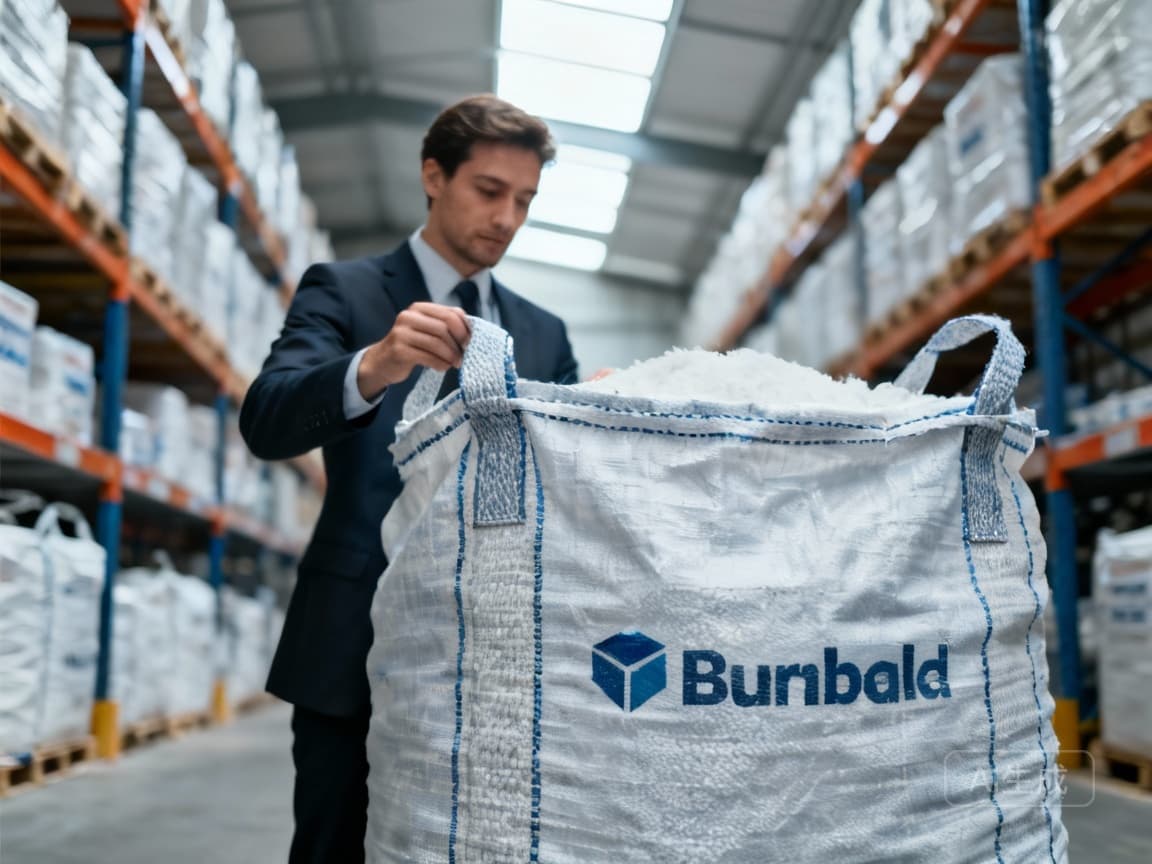
From Bulk Bag to Brand Asset: Drive 30% Supply Chain Value Beyond Logistics #5
RUNCHEN
AuthorWith more than 25 years of experience in FIBC bulk bag manufacturing and sales, RUNCHEN operates its own production facility with stable batch capacity. We specialize in FIBC bulk bags, jumbo bags, ton bags, and customized industrial packaging solutions.
From Bulk Bag to Brand Asset: Drive 30% Supply Chain Value Beyond Logistics
For procurement and supply chain executives, the Flexible Intermediate Bulk Container (FIBC), or bulk bag, is often relegated to a line item—a standardized logistics consumable focused on cost and basic compliance. Yet, a strategic shift is underway. Leading companies are reimagining this humble workhorse as a critical component for product integrity, brand sustainability, and operational intelligence. By looking beyond mere logistics, you can unlock over 30% more value from your supply chain, transforming a simple bag into a strategic brand asset.
The Strategic Blind Spot: Your Bulk Bag is Your First Line of Quality Defense
The prevailing conversation around FIBCs centers on durability and cost-per-use. This misses a fundamental, high-value application: protecting sensitive, high-worth raw materials. Consider the booming global cosmetics market, projected to reach $403.7 billion by 2035, where "clean," "natural," and "pure" are not just marketing claims but core product mandates. The ingredients that power these products—active compounds, essential oils, specialty chemicals—are exceptionally vulnerable to contamination, moisture, and odor transfer during transport.
Here, the bulk bag is not a passive container but the first and most crucial quality checkpoint. A failure here has cascading costs. The case of DSM Nanjing is instructive. By implementing advanced filtration, they reduced particulate emissions from 1,044 mg/Nm³ to under 50 mg/Nm³. Now, consider the reverse: if contaminants or dust infiltrate a bulk bag during shipment, the receiving manufacturer inherits a polluted raw material. The cost of downstream remediation—reprocessing, additional filtration, or even scrapped batches—dwarfs the incremental investment in a high-performance, lined, or static-dissipative FIBC designed for purity.
For brands in cosmetics, pharmaceuticals, and premium food, the bulk bag specification is a direct extension of your product's market promise. Investing in the right protective features is not a logistics cost; it's brand insurance.
From Linear Cost to Circular Asset: The New Economics of FIBCs
The second paradigm shift moves from a linear "take-make-dispose" model to a circular one, where bulk bags become tracked, returnable assets. The compelling proof point comes from an unexpected sector: e-commerce. The Taiwanese leader momo tackled packaging waste by creating a circular system for its shipping bags. They developed reusable "cycle bags" made from recycled plastic film, designed to be used up to 25 times.
This model is directly transferable to industrial packaging. Instead of viewing used FIBCs as waste, forward-thinking companies are piloting "bag pool" systems, optimizing return logistics, and partnering with suppliers for certified cleaning and reconditioning. The economics are clear when you calculate Total Cost of Ownership (TCO). While a reusable or recyclable FIBC may have a higher upfront cost, the long-term savings from reduced procurement, waste disposal fees, and enhanced sustainability reporting create a powerful ROI. It transforms a cost center into a resource stream and a tangible demonstration of circular economy commitment.
Implementation Step: Assess Your Circular Potential
Begin your transition with a simple audit:
- Volume & Flow Analysis: Map your annual FIBC usage, material types, and primary shipping routes.
- Waste Audit: Determine current end-of-life costs (landfill, incineration, recycling fees).
- Partner Evaluation: Engage suppliers who offer take-back programs, refurbishment services, or design for recyclability.
- Pilot Program: Launch a closed-loop trial on a dedicated route to measure real-world cost, durability, and logistical feasibility.
The Intelligent Link: Data-Enabled FIBCs for Predictive Operations
The final frontier integrates intelligence. Just as momo used a "packaging simulation algorithm" to boost forecast accuracy by 30%, FIBCs can evolve into smart IoT nodes. Imagine a bulk bag equipped with a low-cost RFID tag or sensor that monitors internal humidity and temperature throughout its journey. This data provides an immutable chain of custody and enables predictive action.
For instance, real-time moisture data can alert a plant manager that a shipment of hygroscopic powder is at risk of clumping. This allows for proactive scheduling of specialized bulk bag unloaders or pre-conditioning of the material, preventing production line downtime and waste. This intelligence turns the bulk bag from a black box into a transparent, decision-support tool, optimizing the entire "last mile" from receiving to production.
Building Your Strategic FIBC Program
Moving from a transactional to a strategic view of bulk bags requires a cross-functional approach:
- Engage Stakeholders: Connect procurement with R&D, quality assurance, sustainability officers, and brand managers. The conversation must shift from "price per bag" to "value per shipment."
- Specify for Value: Develop technical checklists that tie FIBC properties (static control, barrier layers, recyclable composition) to specific product protection and sustainability goals.
- Demand Data & Innovation: Partner with suppliers who can provide circular service models and pilot smart packaging technologies, using cases like momo's cycle bags as a benchmark for what's possible.
The data is clear. Markets valuing purity and sustainability are growing exponentially. The technology for circularity and intelligence is proven. The question is no longer if your bulk bag is a cost, but what value it can actively create. By repositioning it as a strategic brand asset, you secure your supply chain, future-proof your operations, and build tangible value far beyond the warehouse door.
Related News
Other news you might be interested in
Choosing the Right Bulk Bag Manufacturer for Safer, More Efficient Operations
Learn how to specify bulk bags, evaluate manufacturers, and validate quality and supply reliability to reduce operational risk and support safer, more efficient handling.
The 140th Canton Fair: New Trends in the Export Market for FIBC Bulk Bags, Jumbo Bags, and PP Woven Packaging
Explore how export buyers can evaluate FIBC bulk bags and PP woven packaging beyond unit price. Get practical guidance on specifications, supplier verification, sustainability requirements, and RFQs—and prepare your next sourcing conversation with COSEK.
Want to know more?
Get in touch with us for more information about our services and products.