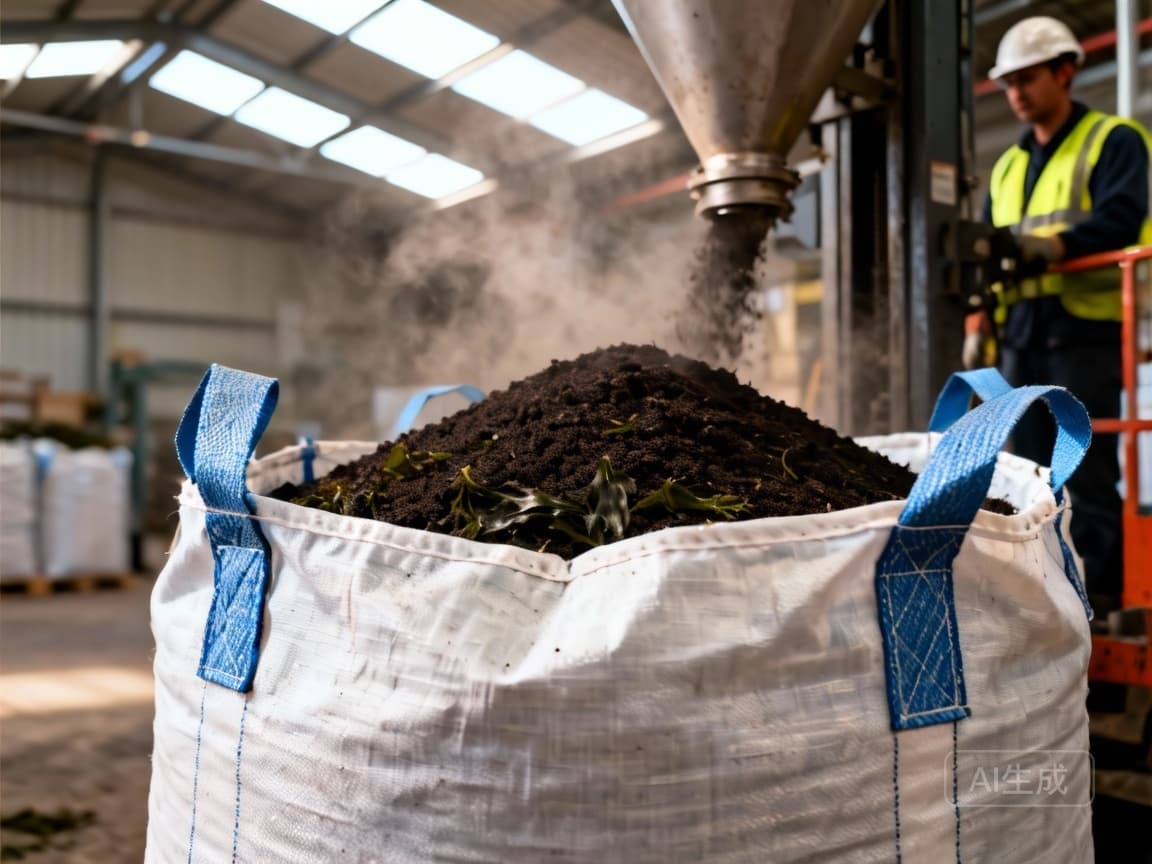
Seaweed fertilizer ton bag design: using packaging engineering to preserve a product value of $5000 per ton # 98
RUNCHEN
AuthorWith more than 25 years of experience in FIBC bulk bag manufacturing and sales, RUNCHEN operates its own production facility with stable batch capacity. We specialize in FIBC bulk bags, jumbo bags, ton bags, and customized industrial packaging solutions.
From 543,000 Tons of Seaweed Fertilizer: How Bulk Bag Engineering Secures $5,000 Per Ton in Product Value
In the high-value world of specialty agricultural inputs, packaging is often relegated to a line-item cost. For products like seaweed-based fertilizers, this perspective is a costly oversight. With a global market producing approximately 543,000 tons annually at an average price of $5,000 per ton, the financial stakes for every shipment are immense. The true cost of a bulk bag isn't its purchase price; it's the value of the product it fails to protect. This article shifts the paradigm, arguing that for sensitive, premium materials, a Flexible Intermediate Bulk Container (FIBC) must evolve from a simple container into a dynamic quality preservation system. We will dissect the specific risks to seaweed fertilizer and translate proven engineering solutions—like those from successful industry cases—into a framework for value preservation that directly impacts your bottom line.
Market Profile and Risk Anatomy: Why Seaweed Fertilizer Tests Bulk Bag Engineering
Seaweed fertilizers represent a growing, premium segment of the agricultural market. Their organic nature and sensitivity make them the perfect case study for advanced packaging. The core challenge is that their value is highly vulnerable between production and end-use. A generic bulk bag invites three critical, expensive risks:
1. Moisture Management Risk: The Silent Degrader
Seaweed extracts are hygroscopic, readily absorbing moisture from the air. This can lead to caking in powders, dissolution of granules, and degradation of active components. A standard bag offers little defense against ambient humidity during maritime shipping or extended storage, potentially turning a premium product into a clumped, compromised mass.
2. Form Preservation Risk: When Granules Become Powder
The physical form—whether granule or powder—is integral to application rates and efficacy. During handling and transport, vibration and pressure can cause granule breakdown (attrition). This not only alters product performance but can also lead to customer rejection, as the delivered specification no longer matches what was ordered.
3. Safety and Contamination Risk: Hidden Liabilities
Dry, powdered organic materials can generate significant static electricity during filling and discharge, creating a potential ignition hazard. Furthermore, extended contact with an unsuitable inner liner could lead to contamination, organic leaching, or failure to meet food-grade or organic certification requirements for certain farming practices.
"The average price of seaweed-based fertilizer is about $5,000 per ton. This high value makes any loss due to moisture, contamination, or degradation a direct and significant hit to profitability." – Market Insights Data
From Case Study to Paradigm: Transferable Engineering Solutions
The path to mitigating these risks is not theoretical; it's demonstrated in existing industrial packaging solutions. By adapting these proven concepts, we can build a protective system for sensitive organics.
Structural Integrity: Lessons from the "Drum" Phenomenon
Consider the challenge faced by Suzhou Xingchen New Material Group Co., Ltd. Their client's bulk bags bulged at the middle ("drum phenomenon") after filling, causing unstable stacking and wasted logistics space. Their engineered solution was the internal baffle (or inner loop) design.
- The Case Solution: Fabric loops were sewn into the bag's interior corners, creating a rigid internal structure that forces the bag to maintain a stable, cubic form when filled.
- The Direct Result: This led to a 30% saving in transportation costs through optimized space utilization in containers and warehouses.
- The Paradigm Shift for Seaweed Fertilizer: Beyond logistics savings, a cube-shaped bag minimizes fabric stress points and reduces shifting and abrasive friction between stacked bags. This directly protects the physical integrity of granules inside. A stable stack is a safer product.
Micro-Environment Control: Customizing the Inner Sanctuary
The Xingchen case also highlights customization for specific materials, mentioning "anti-leakage design." For seaweed fertilizer, we must translate "anti-leakage" into "anti-moisture ingress" and "anti-contamination." This is where material science meets design:
- Functional Liners: A multi-layer polyethylene (PE) liner is standard, but for high-humidity transit, a foil-laminated layer provides a superior moisture barrier. For purity, food-grade or low-migration PE is critical.
- Breathability Management: Some organic materials require minimal gas exchange to prevent off-gassing or anaerobic conditions. Strategically placed breathable patches can balance atmospheric pressure without allowing moisture ingress.
- Static Control: For dry powders, incorporating conductive threads (type C bags) or using static-dissipative fabric (type D) safely grounds any electrical charge during handling, mitigating fire risk.
- Discharge Efficiency: A smooth, low-friction inner liner ensures complete, clean discharge of viscous powders or granules, eliminating waste and cross-contamination—a key insight from chemical industry packaging.
"Internal baffle structure is an effective technical solution to solve bulk bag deformation and improve stacking neatness. Customized design for different material characteristics... is the key to meeting industrial packaging needs." – Implementation Experience from Suzhou Xingchen Case
Value Quantification: The New ROI of Preservation vs. Cost
Evaluating bulk bags on price-per-unit is obsolete for high-value goods. The true metric is Total Cost of Delivery & Value Preservation Rate. Let's quantify the engineering impact.
Visible Cost Savings: The Logistics Dividend
The 30% transport saving from the Xingchen case provides a direct model. For a 20-ton container of seaweed fertilizer ($100,000 value), inefficient, bulging bags might waste space equivalent to 6 tons of product ($30,000). Engineered, cubic bags recapture that space, either as savings on unnecessary shipments or as capacity for more revenue-generating product.
Invisible Value Preservation: The Core of Profit Protection
This is where the major ROI lies. Consider a mere 1% reduction in product loss or degradation.
- On a 20-ton shipment: 1% represents 200 kg of product.
- At $5,000/ton: That's a preserved value of $1,000 per shipment.
- Annual Impact: For a company moving 1,000 tons annually, this 1% preservation equals $50,000 in protected profit, far outweighing the marginal cost of upgraded, engineered bags.
This preserved value manifests as consistent product quality for customers, protection of brand reputation, avoidance of claims, and enhanced supply chain resilience for longer storage or complex logistics.
Conclusion: A New Dialogue with Your Packaging Partner
The procurement of bulk bags for high-value, sensitive products like seaweed fertilizer must transition from a transactional purchase to a technical collaboration. You are not just buying a bag; you are selecting a packaging engineering partner.
Initiate this dialogue with a focus on your product's specific profile. Move beyond basic specifications and discuss:
- Material Science: "What liner composition do you recommend for maximum moisture barrier and organic material compatibility?"
- Structural Engineering: "How can an internal baffle design be optimized for our granule density to prevent attrition and improve stacking?"
- Risk Mitigation: "What static control and breathability features are appropriate for our powder's moisture content and handling environment?"
An engineered bulk bag is the silent guardian of your product's value. From the moment it leaves your facility, through the complexities of global logistics, until it is emptied at its destination, its design is actively working to secure the quality, efficacy, and ultimately, the premium price of every single ton. In a market where 543,000 tons represent over $2.7 billion in value, that guardian is not an expense—it's one of the most intelligent investments you can make.
Related News
Other news you might be interested in
Choosing the Right Bulk Bag Manufacturer for Safer, More Efficient Operations
Learn how to specify bulk bags, evaluate manufacturers, and validate quality and supply reliability to reduce operational risk and support safer, more efficient handling.
The 140th Canton Fair: New Trends in the Export Market for FIBC Bulk Bags, Jumbo Bags, and PP Woven Packaging
Explore how export buyers can evaluate FIBC bulk bags and PP woven packaging beyond unit price. Get practical guidance on specifications, supplier verification, sustainability requirements, and RFQs—and prepare your next sourcing conversation with COSEK.
Want to know more?
Get in touch with us for more information about our services and products.