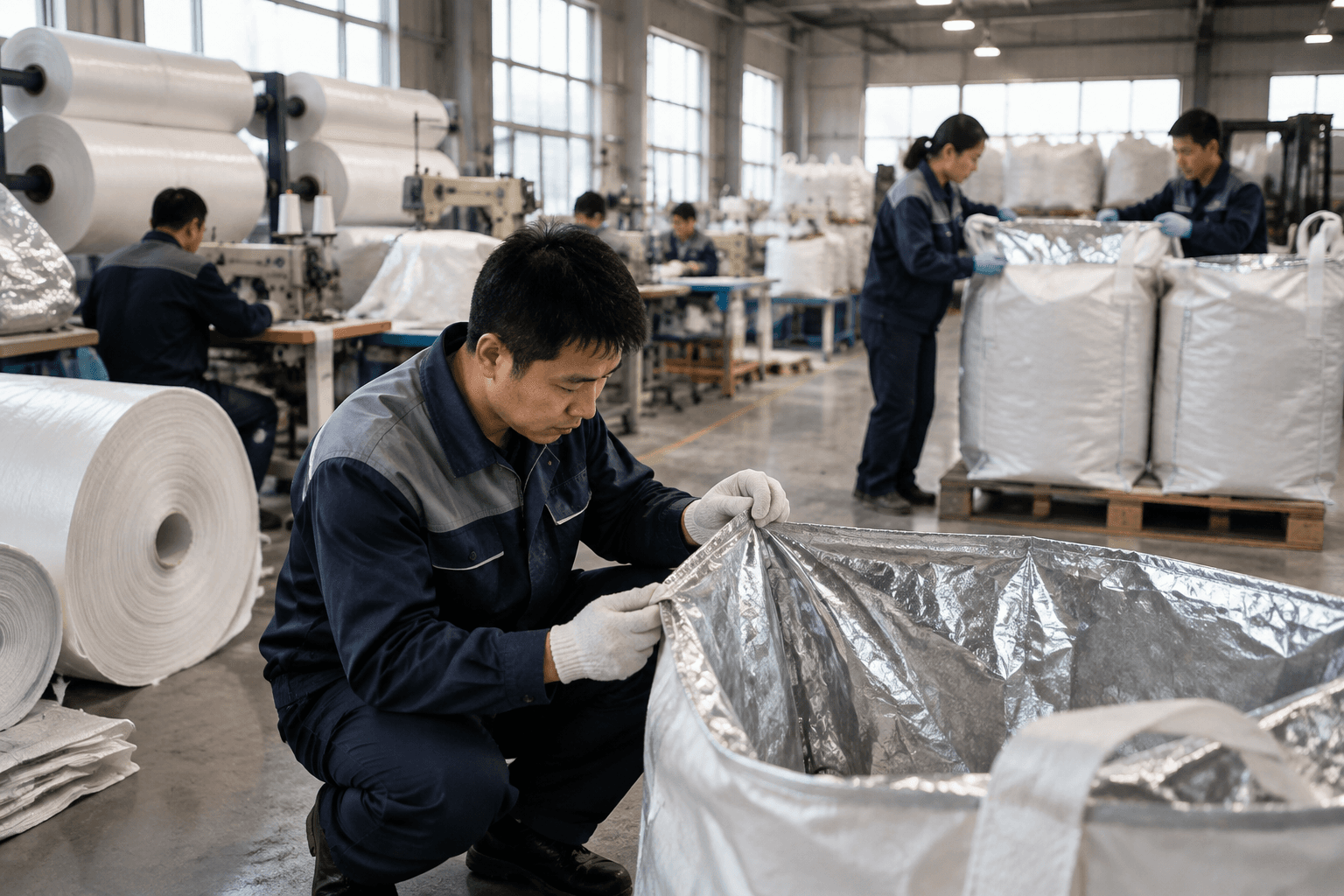
Engineered Ton Bags for Zero-Defect Packaging: Conductive, Formed Liner, and Aluminum Foil Solutions
RUNCHEN
AuthorWith more than 25 years of experience in FIBC bulk bag manufacturing and sales, RUNCHEN operates its own production facility with stable batch capacity. We specialize in FIBC bulk bags, jumbo bags, ton bags, and customized industrial packaging solutions.
The Real Cost of Packaging Inefficiencies in Ton Bag Manufacturing
Every production manager knows the frustration: you have invested in high-speed filling lines, automated systems, and lean processes, yet packaging becomes the bottleneck that undermines it all. Packmate's performance reviews of multi-lane rice packaging machines revealed the same pattern across facilities — lines losing throughput not because of mechanical failure, but because bag performance cannot keep up with filling speed. The result is less output, more manual intervention, and mounting frustration on the floor.
In bulk manufacturing, the stakes extend far beyond lost time. A single bag failure — static discharge, liner collapse, or moisture ingress — can halt an entire line, contaminate a batch, or trigger a costly recall. These are not hypothetical worst-case scenarios; they are documented operational risks that cost producers thousands of dollars per incident in downtime alone. And while one might argue these failures are rare, the cumulative effect of subpar packaging shows up in your OEE, waste percentages, and quality claims every single month.
As one Instagram insight from Packmate put it: "Data isn't just numbers. It's every decision. Every improvement. Every step toward smarter manufacturing." Packaging data is no different. The bags you choose — their construction, liner fit, and barrier properties — generate data that reveals precisely where your margins leak. When you tolerate mediocre packaging, you bake those leaks into your cost structure.
Engineered ton bags are not a commodity expense. They are a strategic investment that reduces risk, accelerates throughput, and protects product integrity. This article shows you exactly how conductive ton bags, formed liner bags, and aluminum foil bags eliminate the hidden costs of standard packaging — and how to get started with a custom assessment tailored to your line.
Why Standard Ton Bags Fail in Demanding Production Environments
The default assumption in procurement is that a ton bag is a ton bag. That assumption is expensive. Off-the-shelf bags are built for generic conditions, not for the specific demands of your product, your filling speed, or your environmental conditions. When you push them beyond their intended limits, they fail — sometimes quietly, sometimes catastrophically.
Static build-up in dry bulk handling is one of the most dangerous and underappreciated hazards. When powders flow through filling spouts, static electricity accumulates on the bag surface. Without a conductive pathway to ground, that charge can damage sensitive electronics, ignite combustible dust clouds, or deliver painful shocks to operators. A spark in the wrong environment is not just a safety incident — it can be a life-threatening explosion.
Liner failures are equally costly. Standard liners shift, wrinkle, or tear during high-speed filling. When a liner folds inward, the bag does not fill completely. When it tears, product leaks. When it wrinkles, seal integrity is compromised. Each of these failures demands operator intervention, slows down the line, and generates waste. Multiply that across thousands of bags per week, and the margin erosion is substantial.
Barrier deficiencies present a third failure mode. Moisture, oxygen, and light degrade sensitive powders, resins, and food ingredients. Standard woven polypropylene bags offer minimal barrier protection. The result: product spoilage, customer complaints, rejected batches, and in regulated industries, compliance failures.
The Advantage Austria Austrian Business in China report highlighted that manufacturers are prioritizing lean, digitized processes and regulatory compliance. Yet packaging is routinely overlooked in these initiatives — an oversight that undermines the very efficiency gains those programs seek. Off-the-shelf bags create hidden costs that show up in OEE, waste, and quality claims. Engineered solutions are a direct fix.
Conductive Ton Bags: Eliminate Static Discharge Risk and Protect High-Value Product
Conductive ton bags (导电吨袋) are engineered with conductive filaments or fabrics woven directly into the bag structure. These conductive elements create a continuous path for electrical charge to flow safely to ground during filling, transport, and discharge. Instead of building up on the bag surface where it can spark, static electricity is dissipated harmlessly.
The use cases are not niche — they are critical. Any facility handling flammable dusts, volatile chemicals, fine powders, sensitive electronics, or materials in explosive environments needs conductive packaging. A single spark in these operations can be catastrophic. Conductive ton bags remove that spark risk at the source.
The benefits extend beyond safety. Conductive ton bags protect sensitive contents from static-related degradation, helping you meet safety compliance standards such as ATEX and Chinese hazardous materials regulations without slowing down production. Operators work more confidently. Inspectors see a facility that takes safety seriously. Insurance premiums reflect the reduced risk.
If your production line handles any product that generates static discharge during filling, request a free static-risk assessment. Our engineers will evaluate your operation and deliver a tailored recommendation within 48 hours — no obligation, just clarity on where your risk stands.
Formed Liner Bags: Precision Fit for Faster, Cleaner Filling
Formed liner bags (成型内膜袋) are pre-formed to match the exact dimensions of your outer ton bag. Unlike standard flat liners that require manual insertion, adjustment, and tucking, formed liners drop into place ready to fill. The result is a cleaner, faster, and more reliable filling cycle.
The operational impact is immediate. Faster filling cycles mean more bags per hour on the same line. Less operator intervention means fewer touchpoints where errors occur. Better seal integrity means fewer leaks, less product waste, and cleaner work areas. Packmate's performance review of multi-lane rice packaging machines confirmed what we see across industries: workflow inefficiencies often trace back to liner handling and misfits — not to the filling equipment itself.
Formed liner bags are ideal for food products, rice, grains, seeds, and any free-flowing product where hygiene and speed matter. They eliminate the wrinkled liner problem entirely. Product flows in smoothly. The bag fills completely. The seal holds. And your line keeps moving.
Want to see the difference yourself? Request a sample kit and run a side-by-side comparison with your current liners on your own line. The data will speak for itself.
Aluminum Foil Bags: High-Barrier Protection for Sensitive Products
Aluminum foil bags (铝箔袋) use multi-layer foil structures to provide superior barrier protection against moisture, oxygen, light, and odors. These are the ton bags you need when product integrity is non-negotiable — when a single point of moisture ingress can spoil an entire batch.
The applications span high-value and highly regulated industries. Pharmaceutical manufacturers package active ingredients in foil-lined ton bags. Food ingredient producers use them to preserve flavor, potency, and shelf life. Fine chemical operations rely on foil barriers to prevent oxidation and moisture uptake. Moisture-sensitive resins and high-value powders demand the same level of protection.
The scale of this demand is well documented. Joincare Pharmaceutical's 2023 annual report highlighted a packaging investment of 25.9846 million — clear evidence that life sciences companies understand how critical barrier packaging is to product quality and regulatory compliance. If you are shipping products where purity, potency, or moisture content matters, foil-lined ton bags are not optional — they are the cost of doing business at a professional level.
The benefits compound over time: extended shelf life, reduced reject rates, maintained product purity, and a brand reputation that survives the test. For technical teams, we provide barrier performance data sheets comparing foil specifications side by side. Ask for the data before you commit — and see exactly what level of protection your product requires.
The ROI of Engineered Ton Bags: Data-Driven Proof from the Field
The case for engineered ton bags is not theoretical. Packmate documented a success story where upgrading bag and liner systems on multi-lane rice packaging machines reduced downtime and improved workflow efficiency across the entire line. The change was not incremental — it was transformative. When bags fit right, fill cleanly, and dissipate static properly, the machine runs at the speed it was designed for.
That same Instagram insight applies here directly: smarter manufacturing is built on data. Track OEE, scrap rate, and changeover time before and after switching to engineered ton bags. The before-and-after numbers tell a clear story. Less downtime. Less waste. Fewer changeovers. Better throughput. These are not marketing claims — they are metrics you can measure on your own floor.
The Advantage Austria report noted that leading manufacturers are focusing on higher employee retention, fair compensation, lean and digitized HR processes, and conformance to GDPR and Chinese Cyber Law. Where does packaging fit into this picture? Engineered packaging supports lean operations by reducing manual handling, minimizing error-prone steps, and enabling traceability through consistent bag quality and documentation. It is not a separate initiative — it is a component of the same operational excellence program.
At Aquatech China 2024, the water industry showcase highlighted growing demand for contamination-free packaging in filtration and treatment chemicals. The message was clear: downstream buyers are increasingly specifying packaging quality as part of their supplier qualification criteria. If your packaging cannot meet the standard, you do not get the contract.
To quantify what engineered ton bags can save you, use our ROI calculator. Input your current scrap rate, downtime hours, and safety incident frequency. The projected savings from conductive ton bags, formed liner bags, or aluminum foil bags will give you the business case you need to present to leadership.
How to Select the Right Engineered Ton Bag for Your Application
Choosing the right engineered ton bag is not guesswork. It is a systematic evaluation that starts with understanding your product, your process, and your risk profile. Follow these four steps to narrow down the right solution.
Step 1: Identify static risk. If you handle combustible dusts, fine powders, or materials prone to static build-up, conductive ton bags are essential — not optional. Assess your filling speed, product conductivity, and environmental conditions. When in doubt, err on the side of safety.
Step 2: Assess moisture and oxygen sensitivity. If your product degrades in humid conditions, oxidizes over time, or loses potency when exposed to light, choose aluminum foil bags or formed liner bags with high-barrier films. Your product's specification sheet will tell you the target moisture or oxygen tolerance. Match the barrier to the requirement.
Step 3: Evaluate automation compatibility. If you run automated filling systems, formed liner bags reduce manual steps and ensure consistent bag dimensions for reliable automated sealing. The fewer human touches, the fewer variables in your process.
Step 4: Test with a pilot order. Do not commit to a full-scale conversion on paper. Run a pilot order, measure line performance, and validate the results before scaling. The data you collect during the pilot will confirm the right specification — or reveal adjustments needed.
Not sure where to start? Schedule a free consultation with our packaging engineers. We will review your product requirements, filling equipment, and operational constraints, then give you a tailored recommendation without any sales pressure.
Implementation Roadmap: From Trial to Full-Scale Conversion
Moving to engineered ton bags does not need to disrupt your operations. A phased approach minimizes risk while building confidence in the solution. Here is how the process works when you partner with us.
Phase 1: Packaging audit. Our engineers review your current bags, filling equipment, product specifications, and pain points. We identify where standard packaging is costing you money — through downtime, waste, product damage, or safety risk. The audit is free and gives you a clear picture of what needs to change.
Phase 2: Sample and pilot. We provide conductive ton bags, formed liner bags, or aluminum foil bags tailored to your specifications for a trial run. You test them on your own line, in your own environment, with your own product. No theoretical claims — just real-world validation.
Phase 3: Measure and optimize. Track OEE, waste, and safety incidents during the pilot. Compare against your baseline. If adjustments are needed — bag dimensions, liner material, conductive filament density — we make them. The goal is a specification that fits your operation perfectly.
Phase 4: Scale and supply. Once the pilot proves out, we scale to full production with consistent quality, reliable lead times, and ongoing support. You lock in the packaging performance that your line needs, and we ensure it stays consistent from batch to batch.
Start your pilot today and receive a dedicated project manager who will guide you through each phase. The process is designed to be low-risk, high-information, and focused on your results.
Why Our Ton Bag Manufacturing Is Built for Partnership, Not Just Supply
Anyone can sell you bags. Few can engineer them to your exact requirements, manufacture them under strict quality control, and stand behind them with technical support. That is the difference between a supplier and a partner.
We operate in-house engineering and manufacturing for conductive ton bags, formed liner bags, and aluminum foil bags. Every bag is produced under controlled conditions, not outsourced to an unknown facility. Our quality systems align with international standards and Chinese regulatory requirements, giving you confidence whether you ship domestically or export globally.
Need custom sizes, printing, or UN certification for hazardous materials? We offer those options as standard capabilities, not special requests. Your packaging should reflect your brand and meet your compliance obligations — without compromise.
Our credibility is built on who trusts us. Packing machine manufacturers rely on our bags to complement their equipment. Food, chemical, and pharmaceutical producers — like those referenced by Packmate and Joincare Pharmaceutical — depend on our packaging to protect their products. These are not casual buyers. They demand performance, and they stay because we deliver.
Want to see our operation for yourself? Request a factory tour or virtual audit to inspect our production lines and quality controls. Transparency is our strongest selling point.
Your Next Step to Zero-Defect Bulk Packaging
Engineered ton bags — conductive, formed liner, and aluminum foil — reduce risk, cut costs, and improve ROI in ways that standard packaging simply cannot match. Static discharge eliminated. Liner failures prevented. Product integrity preserved. Every section of this article points to the same conclusion: the packaging you choose is not a commodity — it is a competitive advantage waiting to be claimed.
We offer a free packaging assessment and ROI projection tailored to your production line. This is not a generic report — it is a specific, data-driven analysis of where your current packaging is leaking margin and how engineered ton bags can stop it. Fill out the form or call to speak with a ton bag specialist today.
For technical teams that want to dig deeper before talking to anyone, download our "Engineered Ton Bag Selection Guide" for technical specifications and case studies. It covers conductive ton bags, formed liner bags, and aluminum foil bags in detail, with real-world performance data.
Pilot slots are limited this quarter because our engineering team works directly with every pilot customer. If you want to start improving your packaging line before the next production cycle, contact us today to secure your pilot slot.
Ready to eliminate packaging-related downtime? Book your free packaging assessment now — no obligation, just a clear plan to zero-defect bulk packaging.
Related News
Other news you might be interested in
How Super Sacks Differ From Bulk Bags, FIBC Bags and Others
Super sacks, bulk bags, and FIBC bags are not interchangeable. Learn the key differences, how engineered bulk bags reduce waste and speed filling, and how to get a free sample kit and quote.
How COSEK White Cylindrical Leak-Proof Bulk Bags Cut Downtime and Drive ROI in High-Volume Manufacturing
Discover how COSEK's white cylindrical leak-proof bulk bags eliminate downtime, product loss, and compliance risks in high-volume manufacturing. Get the spec, sample, or line trial to improve OEE and ROI.
Want to know more?
Get in touch with us for more information about our services and products.