Stop Wasting $5,000/Ton: Bulk Bags as Strategic Logistics Assets #101

RUNCHEN
AuthorWith more than 25 years of experience in FIBC bulk bag manufacturing and sales, RUNCHEN operates its own production facility with stable batch capacity. We specialize in FIBC bulk bags, jumbo bags, ton bags, and customized industrial packaging solutions.
Stop Wasting $5,000/Ton: Reimagining Bulk Bags as Strategic Logistics Assets
In the complex calculus of modern supply chains, bulk bags (FIBCs) are often relegated to a simple line item: a packaging cost. Procurement decisions frequently default to the lowest price per unit, overlooking the profound impact this "container" has on total landed cost and risk exposure. This mindset is a costly oversight. Real-world data and industry shifts demand a strategic pivot—from viewing bulk bags as a commodity expense to recognizing them as engineered assets for logistics efficiency and capital protection. This article provides a data-driven framework for making that shift, translating bag specifications into direct business outcomes.
The Hidden Cost of Unused Space: Your Logistics' "Beer Belly"
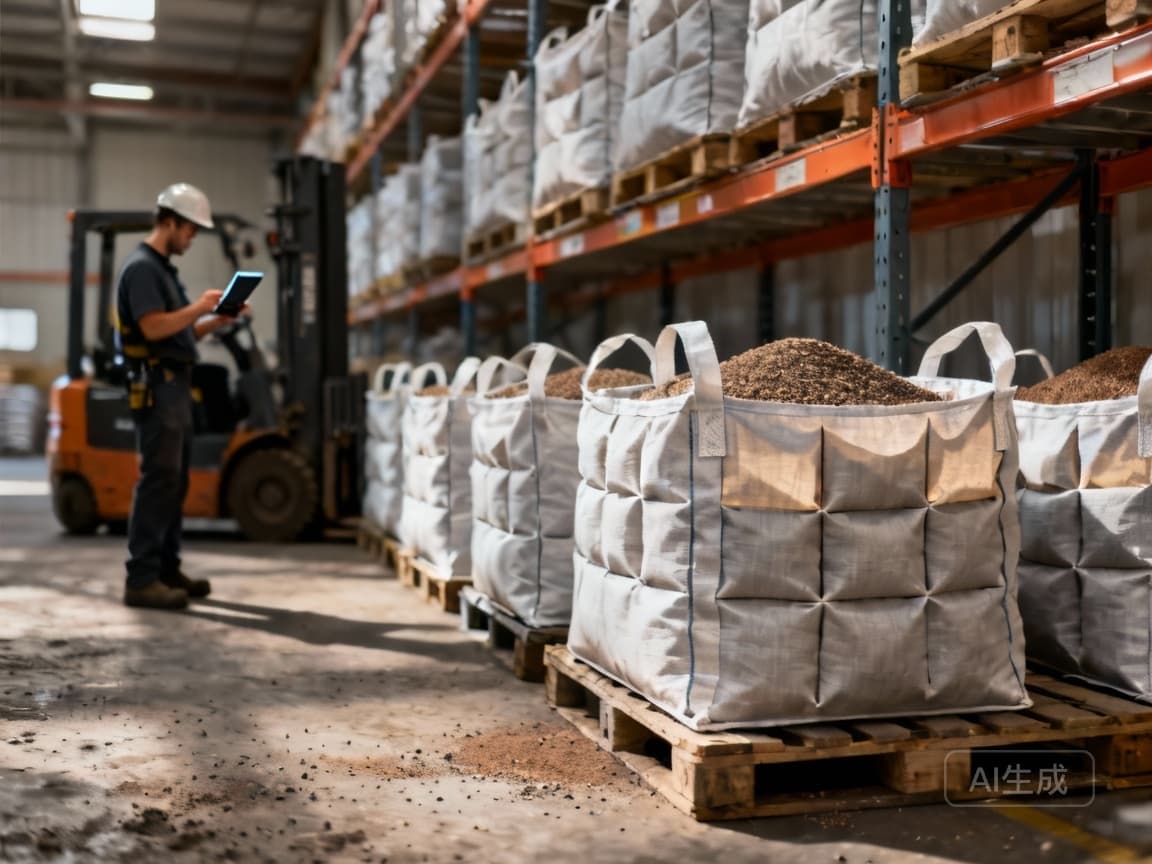
Consider a fundamental question: what is the cost of one cubic meter in your warehouse or shipping container? For most businesses, storage and transportation represent a significant portion of their COGS. Yet, a common phenomenon directly undermines this efficiency: the "bulging" or "beer belly" effect in standard bulk bags. When a bag loses its shape, it fails to utilize the available volumetric space fully, creating air gaps and unstable stacks.
The financial implication is not theoretical. Consider the experience of Suzhou City Star New Material Group Co., Ltd.. Faced with the challenge of bags bulging at the middle after filling—leading to wasted storage and transport space—they implemented a solution focused on geometry: internal loop (拉筋) bulk bags. By sewing reinforced loops at the interior corners, the bag maintains a straight, square shape when filled. The result was a direct and substantial logistics gain: a 30% saving in transportation costs. This case is not about a marginally better bag; it's about packaging engineering that actively reshapes freight budgets.
"The internal loop design is an effective structural solution to the problem of bulk bag deformation during loading. The regular shape facilitates stacking and maximizes the use of transport and storage space." – Implementation Experience, Suzhou City Star Case.
This experience from Suzhou, echoed by producers like Zibo Muguang Plastic Products and Dongxing Plastic Industry, highlights a universal principle: space utilization is a direct lever on logistics spend. An unstable, bulging bag cannot be stacked efficiently, potentially reducing trailer or container capacity utilization from 100% to 70% or less. The cost of that wasted 30% of space is pure financial leakage.
Actionable Guidance: Conduct a Space Audit
To quantify this opportunity for your operation, follow these steps:
- Calculate Your Space Cost: Determine your average cost per cubic meter for key transportation lanes (e.g., truckload, container) and storage.
- Analyze Current Bag Performance: Photograph and measure your loaded bags in a stacked configuration. What percentage of the pallet or container footprint is actually occupied by product versus air?
- Model the Improvement: If optimized, square-shaped bags could increase your payload per shipment by 15-30%, what is the annual freight savings? Use the formula: Annual Savings = (Current Shipments) x (Freight Cost/Shipment) x (% Potential Space Gained).
This exercise shifts the conversation from "bag price" to "cost per shipped ton," where the true value of structural integrity is revealed.
Risk Pricing: Is Your Packaging Worthy of Your Cargo?
The second strategic pillar moves beyond efficiency to asset protection. Here, the guiding question is stark: Are you using a $5 packaging solution to protect $5,000 worth of goods? The disconnect between cargo value and packaging specification is a critical risk blind spot.
Examine the market for high-value, sensitive materials like seaweed-based fertilizers. Market insights indicate that in 2024, the global average price for these products is approximately $5,000 per metric ton, with significant variation. The global production volume of roughly 543,000 tons underscores a substantial market where loss or degradation carries severe financial consequences. For such cargo, generic "protection" is insufficient. A 1% loss due to moisture, contamination, or static discharge translates to a $50 loss per ton—quickly eroding margins and potentially creating safety hazards.
This is where bulk bag specifications must be matched to risk. The case studies emphasizing shape retention are about more than space; for fragile granules or sensitive compounds, maintaining shape minimizes shifting and particle breakdown. The requirement moves from simple containment to value-adapted protection.
Actionable Guidance: Build a Risk-to-Specification Matrix
Develop a decision framework that links cargo profile to bag features. Use the following matrix as a starting point for discussions with your packaging engineer or supplier:
- Risk: Moisture Absorption/Hydrolysis (e.g., fertilizers, certain chemicals)
Specification: Liner bags (low-density polyethylene, LDPE), coated fabrics, or lamination with high moisture barrier properties. - Risk: Static Discharge (e.g., flammable powders, plastic resins)
Specification: Type C (conductive) or Type D (dissipative) bags with proper grounding protocols or static-dissipative fibers. Understand the critical difference for your material's MIE (Minimum Ignition Energy). - Risk: Contamination & UV Degradation (e.g., food-grade products, pigments)
Specification: FDA-approved materials, anti-static treatments where needed, and UV-inhibited fabrics for outdoor storage. - Risk: Loss of Shape & Stacking Instability (e.g., any dense material)
Specification: Internal loop design, reinforced lifting loops, and higher fabric safety factors (e.g., 6:1 or 7:1).
Present this matrix alongside your cargo's value per ton. The investment in higher-specification bags becomes a justifiable insurance premium against quantifiable loss.
A Strategic Procurement Framework for FIBCs
Integrating these two principles—space economics and risk pricing—requires a new approach to procurement. The goal is to select the bag that delivers the lowest total cost of ownership (TCO), not the lowest unit price.
Implementation Steps for Supply Chain & Procurement Leaders
- Assemble a Cross-Functional Team: Include logistics (understands space costs), operations (understands filling/handling), and safety/environmental (understands risk) stakeholders. Move the decision beyond procurement alone.
- Profile Your Material: Document its value per ton, density, flow characteristics, and specific sensitivities (moisture, static, light, contamination).
- Map Your Logistics Chain: Identify all touchpoints: filling, indoor/outdoor storage, transport mode, stacking height, discharge method, and disposal/reuse requirements.
- Define Critical Performance Indicators (KPIs): Shift KPIs from "cost per bag" to:
- Cost per successfully delivered ton.
- Space utilization percentage per shipment.
- Incident rate (tears, contamination, moisture damage).
- Partner with an Engineering-Driven Supplier: Engage suppliers who ask detailed questions about steps 2 and 3. Provide them with the Suzhou City Star case or your risk matrix. Evaluate their ability to provide data, test samples, and tailored solutions—not just a catalog.
- Run a Pilot: Test the proposed high-performance bag (e.g., internal loop design with a specific liner) against your current standard. Measure the real-world difference in stackability, handling, and material condition upon arrival.
- Calculate Total Cost of Ownership (TCO): For the pilot, factor in: Bag Cost + Freight Cost (adjusted for improved density) + Handling Cost + Risk Cost (estimated reduction in loss). Compare this TCO between the old and new solutions.
Conclusion: From Cost Center to Value Engine
The evidence is clear. As demonstrated by documented successes in optimizing space, and as demanded by the economics of high-value commodities like seaweed fertilizer, bulk bags are a pivotal strategic lever. They are not a passive container but an active tool for managing two of the supply chain's most pressing mandates: cost efficiency and risk mitigation.
The journey begins with a change in perspective. Stop asking, "How much does this bag cost?" Start asking, "How much does this bag save?" and "How much value does this bag protect?" By applying the space audit and risk-matrix framework, you can transform your FIBC procurement from a tactical purchase into a strategic investment—one that protects your margins, your cargo, and your competitive advantage. In an era of volatile logistics costs and complex global supply chains, that is not an optimization; it is a necessity.
Related News
Other news you might be interested in
Choosing the Right Bulk Bag Manufacturer for Safer, More Efficient Operations
Learn how to specify bulk bags, evaluate manufacturers, and validate quality and supply reliability to reduce operational risk and support safer, more efficient handling.

The 140th Canton Fair: New Trends in the Export Market for FIBC Bulk Bags, Jumbo Bags, and PP Woven Packaging
Explore how export buyers can evaluate FIBC bulk bags and PP woven packaging beyond unit price. Get practical guidance on specifications, supplier verification, sustainability requirements, and RFQs—and prepare your next sourcing conversation with COSEK.
Want to know more?
Get in touch with us for more information about our services and products.